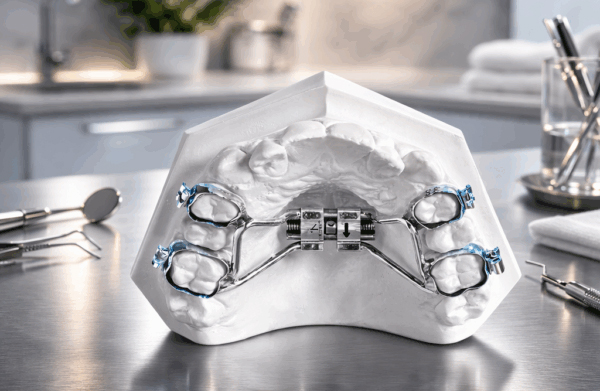
rapid maxillary expansion appliance

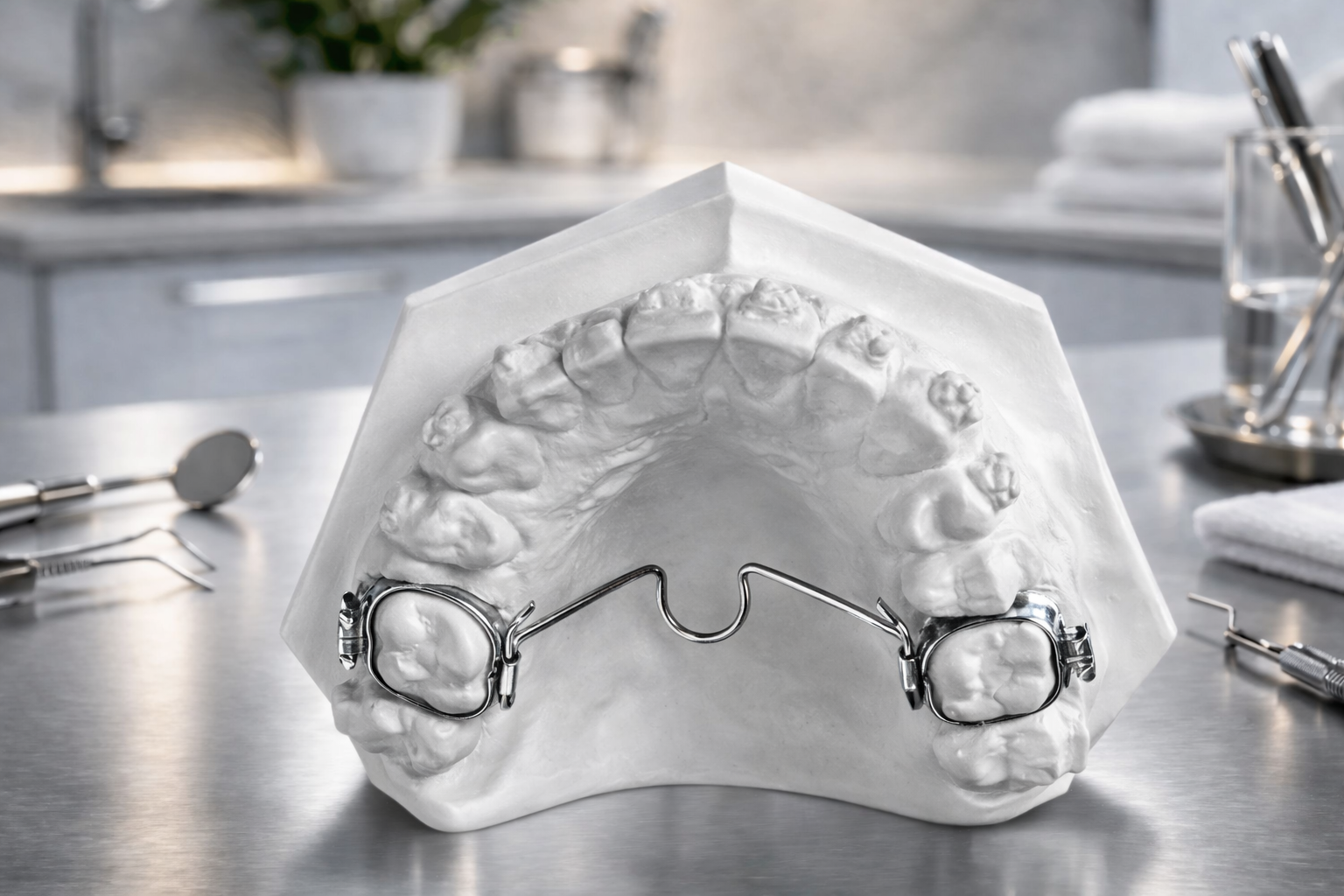
The rapid maxillary expansion appliance consists of a special screw (Hyrax screw), which is welded to the bands of deciduous molars or premolars and molars and then firmly cemented in place. By turning the screw, the upper jaw is expanded in the area of the growth suture in the middle of the palate (sutura palatina mediana). As a clinical sign of successful upper jaw expansion, a temporary gap between the central incisors (diastema) appears. In addition to conventional rapid maxillary expansion, there is also the option of connecting the Hyrax screw with lateral acrylic bite blocks and cementing it in place. The indication and duration of wear correspond to those of conventional rapid maxillary expansion. Another form of the rapid maxillary expansion appliance is the hybrid Hyrax. In this case, a conventional rapid maxillary expansion appliance is combined with mini-implants in the anterior region of the palate.

Pendulum

The Pendulum appliance features a palatal anchorage and is attached to premolars and molars via bands. With the aid of activatable elastic elements, distalization of the molars or premolars can be achieved, thereby creating space in the posterior region of the upper jaw independently of patient compliance.

Transpalatinalbogen (TPA)

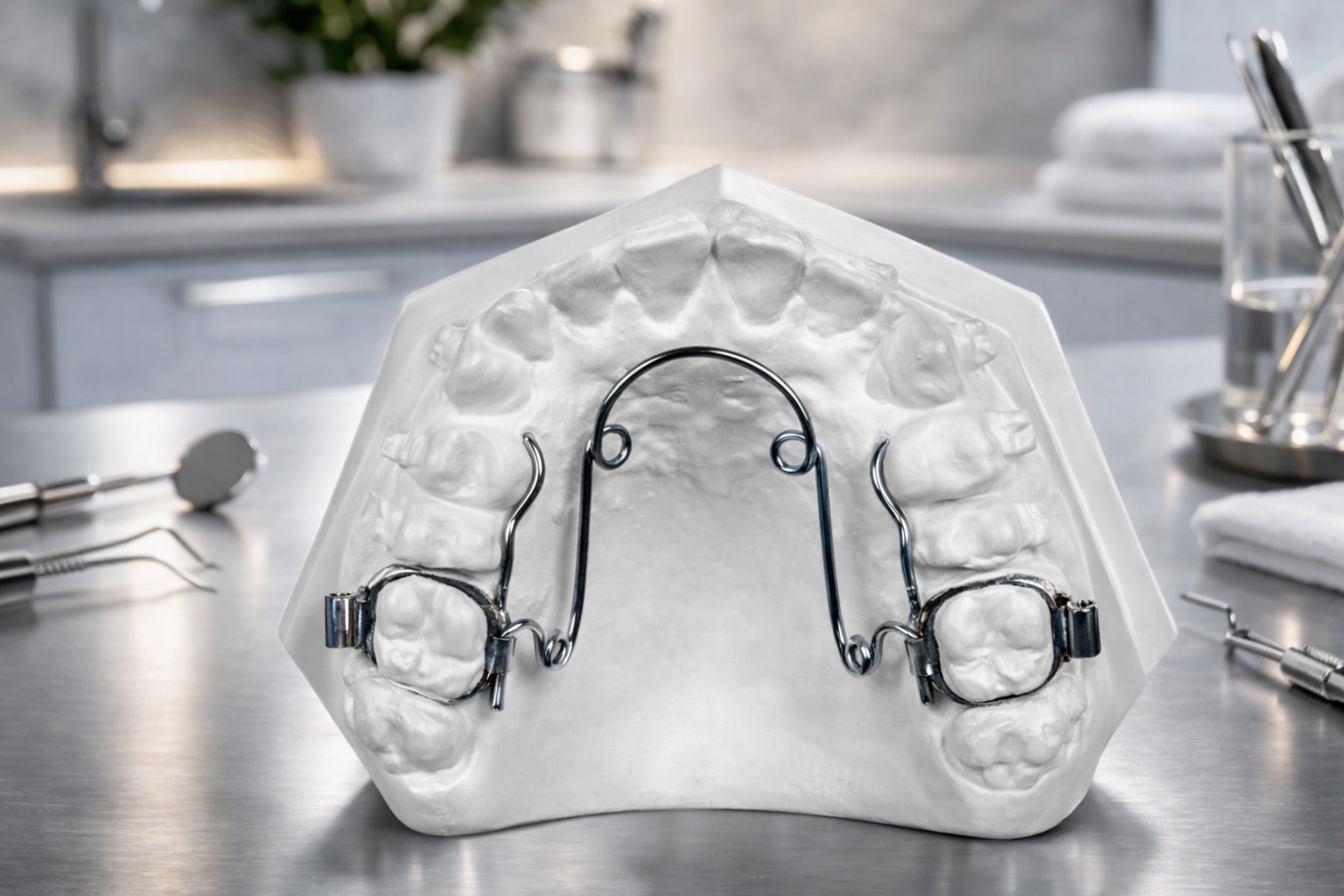
The transpalatal arch, also known as a palatal bar, connects the bands of the first molars using a wire running along the palate. This keeps the first molars in position in the sagittal and transverse planes.

Quad-Helix (QH)

The quad helix consists of a spring framework running along the palate with four circular loops, which is attached to the maxillary molar bands. Depending on the activation, the upper jaw is expanded in the anterior or posterior region.

Lip Bumper (LB)

The lip bumper works by utilizing the body's own forces and is inserted into tubes attached to the molar bands of the lower jaw. Lip pressure is transmitted via the lip shield to the first molars, causing the first molars to be held in position or to undergo slight distalization.

Lingualbogen (LA)

The lingual arch, also known as a lower lingual arch, is attached to the molar bands of the mandible and prevents mesialization of the first molars by resting against the incisors.

Forsusfeder

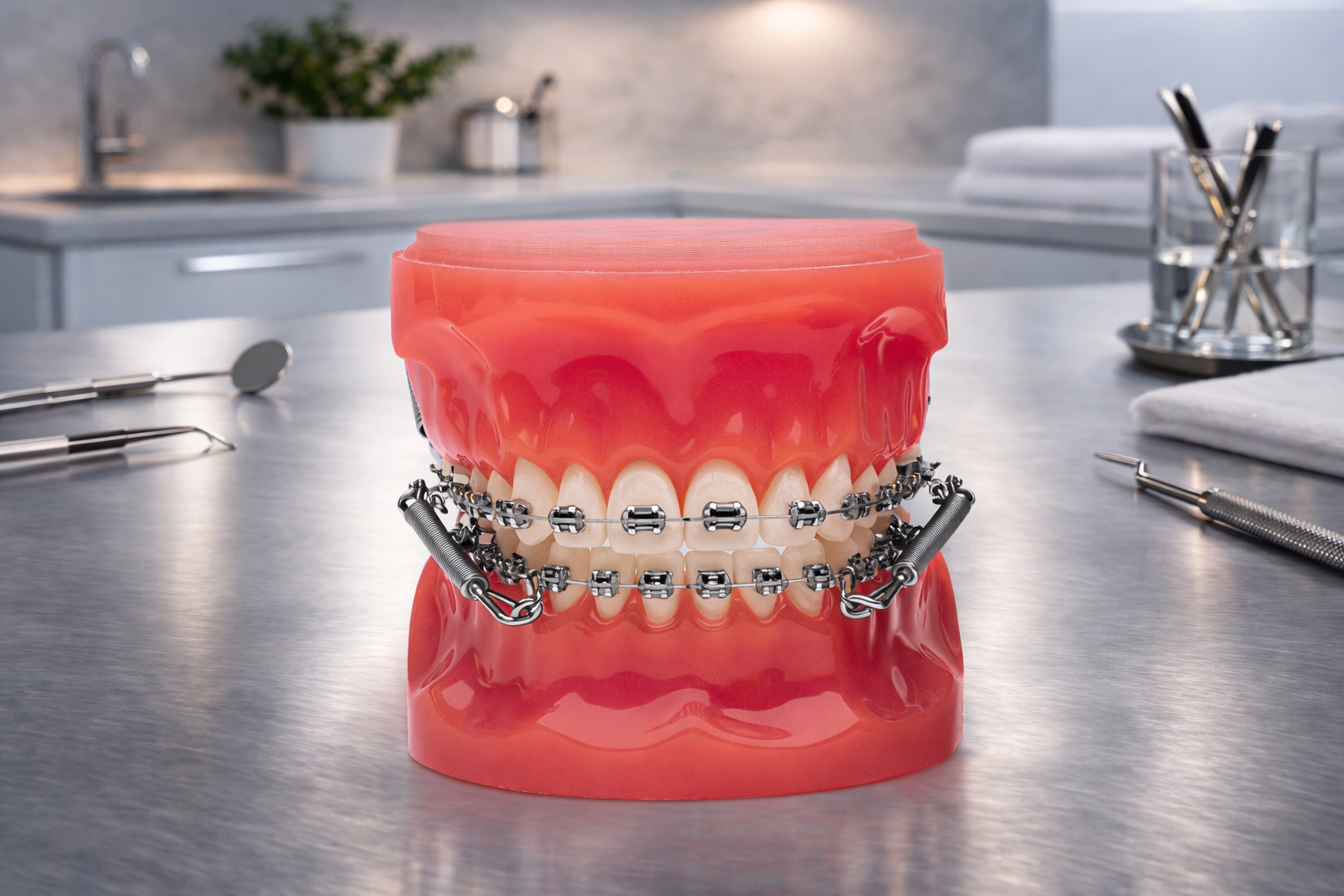
Die Forsus-Feder wird an die festsitzende Apparatur aufgeklipst und verfügt über ein Teleskopelement mit Federn. Dieser Vorschubmechanismus ermöglicht zeitgleich eine Bisskorrektur und die vorverlagerung des Unterkiefers.

Langzeit-Kleberetainer (KR)

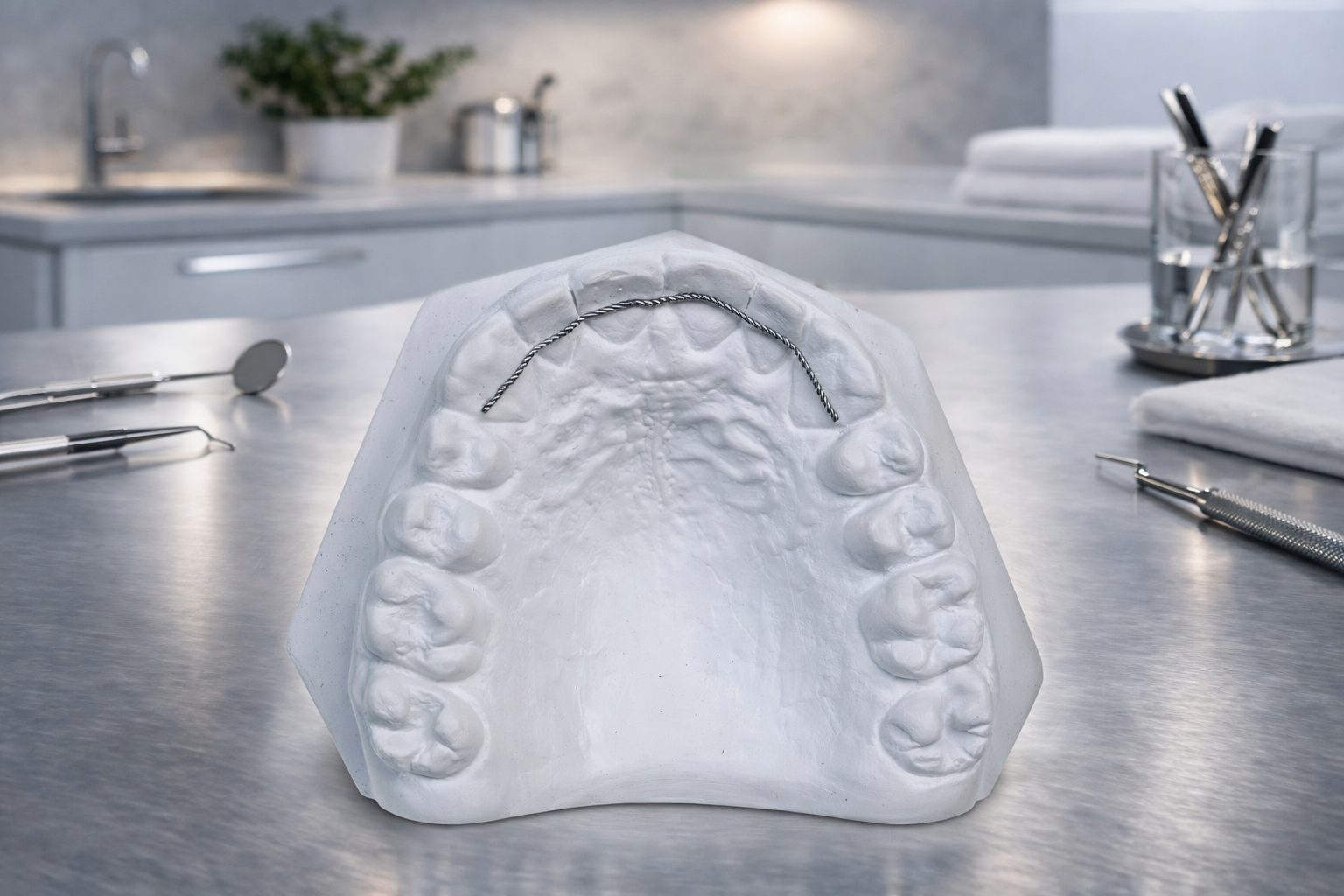
The long-term retainer consists of a thin wire that permanently stabilizes the teeth. It is bonded to the inner surfaces of the incisors and canines and is virtually invisible. After a short adjustment period, the retainer is very comfortable to wear. This makes it a particularly reliable and recommended method for ensuring that the patient’s orthodontic treatment results are maintained long-term.